Spaced Repetition Explained Simply
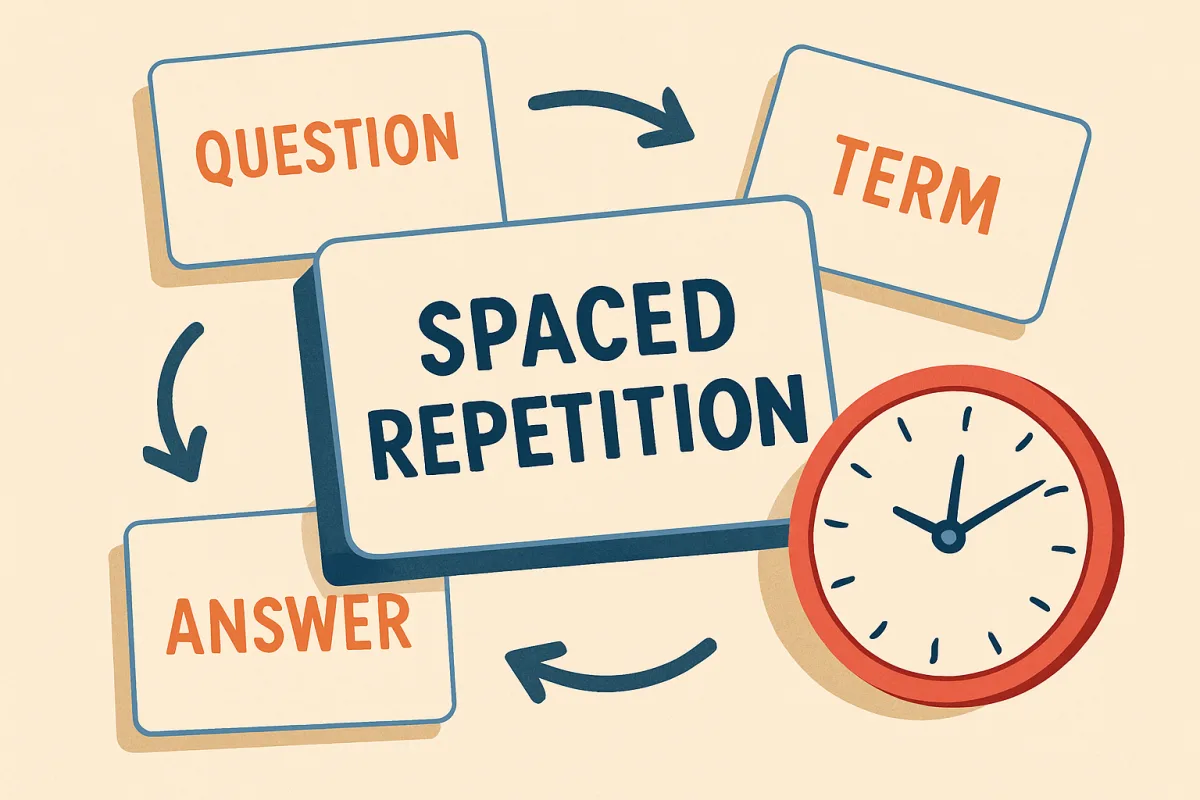
Spaced repetition is a learning technique that involves reviewing information at increasing intervals to enhance memory retention. This method leverages the psychological spacing effect, where information is more easily recalled if it is studied over spaced intervals rather than crammed in a short period. It is particularly effective for memorizing vocabulary, facts, and concepts, making it popular among students and language learners.
Quick Summary
Spaced repetition is a powerful learning strategy that optimizes memory retention by revisiting information at spaced intervals. This technique helps learners effectively manage their study time and improve recall, making it especially useful for language acquisition and exam preparation.
Curator Notes
Spaced repetition is grounded in cognitive psychology and is designed to combat the forgetting curve, which suggests that information is lost over time if not actively reviewed. By spacing out review sessions, learners can reinforce their memory and ensure that knowledge is retained more effectively. This method is often implemented through flashcards and software applications that automate the scheduling of reviews based on individual performance and recall rates.
One of the key advantages of spaced repetition is its adaptability. It allows learners to focus on areas where they struggle while minimizing time spent on concepts they already know well. Popular tools like Anki and Quizlet utilize algorithms to determine optimal review times, making the learning process more efficient.
This approach not only saves time but also enhances long-term retention, making it a favored strategy among educators and self-learners alike.
Recommended Options
- Anki: Best for students and self-learners seeking customizable flashcard systems Anki offers powerful spaced repetition algorithms and extensive customization options. Signal checked: Highly rated by users for its effectiveness in memorization and flexibility. Alternative to consider: Quizlet
- Quizlet: Best for students looking for a user-friendly interface and collaborative features Quizlet provides a variety of study modes, including games and quizzes, making learning engaging. Signal checked: Widely used in classrooms and has a large user community. Alternative to consider: Brainscape
- Brainscape: Best for learners who prefer a structured learning path with pre-made flashcards Brainscape uses a unique confidence-based repetition system to enhance learning. Signal checked: Positive reviews for its effectiveness and ease of use. Alternative to consider: Memrise
Best Sources
Videos and Community Signals
What is spaced repetition? Spaced repetition is a learning technique where you review material and increasingly spaced intervals ...
Track your sleep, movement, and recovery metrics with the Ultrahuman Ring AIR and use the code KARLAVILLO30 to get 30% off ...
Comparison
| Decision Point | Good Starting Choice | When to Go Further |
|---|---|---|
| Customization options | Quizlet offers basic customization for flashcards. | Anki provides extensive customization, allowing for tailored study experiences. |
| User interface | Quizlet has a more intuitive and visually appealing interface. | Anki's interface is functional but may require a learning curve. |
| Community resources | Quizlet has a large database of user-generated content. | Anki allows users to create and share decks, but the community is smaller. |
FAQ
The forgetting curve illustrates how information is lost over time when there are no attempts to retain it. Spaced repetition helps combat this by scheduling reviews.
By revisiting information at spaced intervals, learners reinforce their memory, making it easier to recall information long-term.
Yes, spaced repetition can be applied to various subjects, including languages, science, and history, making it a versatile learning tool.